Colson “Tugboat” Holland & The Partner — together since 2021. A partnership built on trust, chemistry, and one guy doing 94% of the work.
One championship · One wedding · Zero chip shots
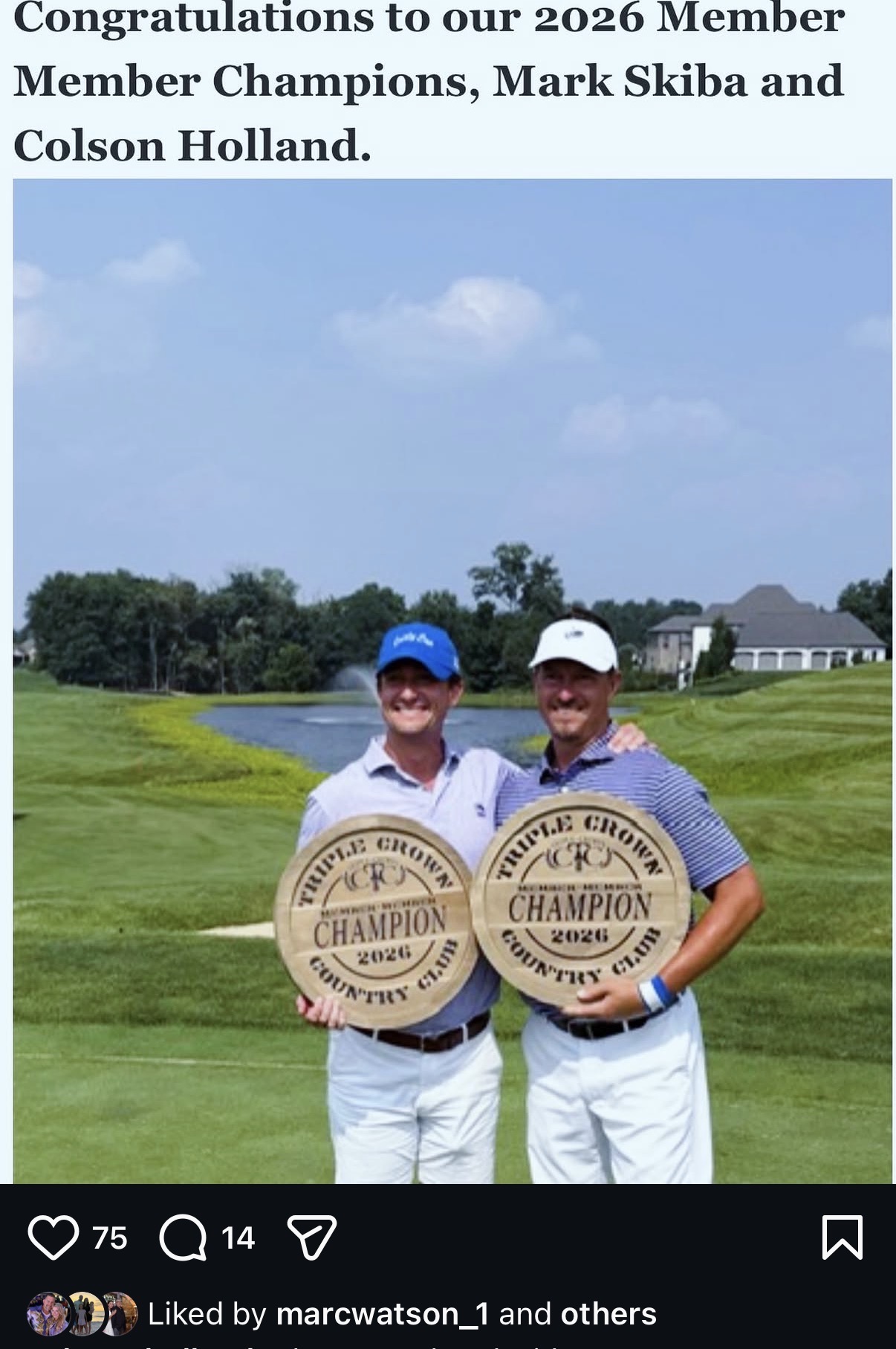
“Congratulations to our 2026 Member-Member Champions, Mark Skiba and Colson Holland.”
Two plaques. Two names. One of these men chunked a chip on the last hole. We will get to that.
There are wins, there are big wins, and then there is what happened at the 2026 Triple Crown Member-Member,
where Colson Holland and The Partner etched their names into a plaque that will hang in
a hallway people walk past on the way to the bathroom for the next forty years. Immortality. Real, tangible immortality.
This website exists for two reasons. The first is to permanently document that championship so that no member,
guest, groundskeeper, or future Holland child can ever claim it did not happen. The second is that Colson is getting
married on Saturday, August 29th, and we felt a full-scale public roast was more
economical than a gift off the registry.
1Triple Crown Title
68MPH Career Fastball
0Of Dad's Shoes Filled
1Chunked Chip, 18th Hole
41'Uphill Bender, Same Hole
∞Leagues Out Of His
The Partnership
Two men. One trophy. A wildly uneven distribution of labor.
Colson “Tugboat” Holland
CFOCarlisle & BrayC&B MarineC&B Energy
Chief Financial Officer of Carlisle & Bray Enterprises, which is how he got the nickname, or so he
would very much like you to believe. Low center of gravity. Enormous heart. Wedge game that has been described by
at least one playing partner as “a hate crime against the golf ball.” Son of Dr. Ed Holland, the best
eye surgeon in the world — a fact he works into conversation at a rate of roughly once per nine holes, and
a set of shoes he will not come within four sizes of filling.
The Partner
CloserIce In VeinsActual Golfer
Handed Colson as a partner at the last minute in 2021, having never met him, and won their flight that same
day — which tells you everything. They lost the all-flights playoff that year. Five years later they came
back and took the whole thing. What we know is this: when the tournament
was on the line and his partner had just delivered the single worst golf shot in recorded Triple Crown history,
he stood over a 41-foot uphill double-breaker and rolled it into the center of the cup like he was mailing a letter.
He did not celebrate. He picked the ball out, tossed it to Colson, and said nothing. That is the whole personality.
That is all you need.
Start Here
Two full pages on the championship. The rest is character evidence.
Not their first rodeo. Two strangers in 2021, a flight title that same afternoon, and five years later the whole thing.
Member-Members are decided by a small number of moments, and the 2026 Triple Crown was decided by
roughly nine of them. In eight of those nine, The Partner did something that should
not have been physically available to him. In the ninth, Colson Holland hit a chip shot that we have given
its own dedicated page, because it could not be contained within this one.
What follows is the official record of the run, assembled from scorecards, secondhand accounts, and at least
three men who were not there but tell it better than the men who were.
2021: The Origin
Paired at the last minute. Total strangers. Won their flight — and then lost the one that counts.
This is the part that reframes the entire 2026 championship, so pay attention. Colson Holland and
Mark Skiba did not build this partnership over years of practice rounds and shared strategy. At the
2021 Triple Crown Country Club member tournament they were thrown together
at the last minute — a scheduling fix, not a plan — shook hands on the first tee as
complete strangers, and then won their flight. First time out. Never met before that morning.
2021. The morning they met. Note the body language of two men who have known each other
for roughly four hours. By the end of the day they had won their flight. The playoff would be a different conversation.
Think about what that means from Mark Skiba’s side. A man turns up to a tournament, is handed a partner
he has never laid eyes on with essentially no notice, and wins his flight. That is not luck — that is a man
who was going to win regardless of who got assigned to him, and Colson Holland happened to be standing there
when the pairings got redrawn.
The board. Marker on a laminated sheet, which is exactly how a real member-member records history.
It is all right there.Holland / Skiba — a 13 in red — then 6, 6, 4, 6
— 22 — and 26½, boxed in red pen by somebody who understood
exactly what they had just watched. Clancy underneath, forever. No trophy, no plaque, no Instagram post.
Just two names in a hand that was clearly in a hurry.
And then they lost.
Because winning your flight is not winning the tournament. Winning your flight gets you into the
all-flights playoff — the flight winners against each other, sudden death,
for the actual title. In 2021, two strangers who had been introduced that morning made it all the way to that
playoff and did not come out of it.
They got to the door. They did not get through it.
Now hold that thought and go read the 18th hole.
Because in 2026 they won their flight again, and again it came down to an all-flights playoff, and again it
went to sudden death — the exact stage where it had ended for them five years earlier. Same two men.
Same unfinished business. And with a stroke in hand and a two-tiered green in front of him,
Colson Holland reached for a 60-degree wedge.
So by the time 2026 came around, this was not their first rodeo. Five years. A flight title
as strangers, a playoff loss that nobody ever quite let go of, and somewhere in the middle Colson slipped off and
won the 2025 TCCC Masters with a different horse entirely. The man has been assembling a portfolio of other
people’s good rounds since the Biden administration.
Five years, one unfinished playoff, and one consistent variable. It is not Colson.
Tournament analysis, 2026
The Format
For the four people reading this who do not play golf.
Two members, one team, best ball, brackets, flights, and a level of intra-club hostility that would alarm an
outside observer. You are not just trying to win. You are trying to win against a guy you will have to see at the
pool on Sunday. There are no neutral matches at a Member-Member. There is no such thing as a friendly 4&3.
The Triple Crown is the one that counts. Everyone knows which one is the one that counts.
The Matches
A partial accounting. Names withheld to protect the wounded.
Match 1 — The Warning Shot
Nobody expected anything from this team. That is not us being mean, that is the actual pre-tournament read.
They were a coin flip to get out of their flight. Then on the 4th hole, from 212 yards, out of a fairway bunker,
with a lip, The Partner hit a shot that landed eleven feet from the pin and
spun back to four. Colson later described the sound it made off the club as “wrong, in a good way.”
Word got around the course before they finished the front nine.
Match 2 — Colson's One Good Hole
We want to be fair to the man. On the 7th, Colson Holland made a genuine, unassisted, nobody-helped-him birdie
from 140 yards, and he has talked about it more than most people talk about the birth of their children. He has
described the yardage. He has described the wind. He has described what he was thinking. He does not describe
what happened on any of the other seventeen holes. He did, however, find time on the 8th tee to mention that his
father is the best eye surgeon in the world, which is true, and which had nothing to do with anything.
Match 3 — The Snowman That Did Not Matter
Colson posted an 8 on a par 4. An eight. On a par four. In match play, where you are allowed to pick up.
He did not pick up. He played the whole thing out, in front of everyone, because he said he “wanted to see
if he could still make bogey,” which he could not, because the number was already 6 when he said it.
They won the hole anyway. You can guess how.
Match 4 — The Blackout Stretch
Five consecutive holes where The Partner did not make a putt longer than
eight feet and did not miss one shorter. Nothing dramatic. No fist pumps. Just a man methodically removing hope
from two other men, one green at a time. The opposing team stopped talking somewhere around the 13th. Their cart
ride in was described by a witness as “a funeral where nobody had died yet.”
Match 5 — The Semifinal Nobody Believed
Down two with three to play. Colson had, at this point, contributed a total of one hole across the entire back nine,
and that hole was a conceded par. The Partner proceeded to birdie 16, birdie 17,
and halve 18 with a par he made from a spot on the property that does not appear in the yardage book.
Two down became all square became a win.
The Final — See The Next Page
It went to a sudden-death playoff. The other team posted bogey. Colson had a stroke, eleven feet of fringe,
a perfect lie, a putter in the bag, and an assignment so simple it barely qualified as one.
He made the wrong decision.
The Confession
He wrote it himself. He posted it. It is still up.
On October 26th, 2025, after winning the TCCC Masters at Triple Crown Country Club with a
different partner entirely, Colson Holland went on Instagram, posted a photo of the two of them, and
captioned it — in his own words, of his own free will, with his whole chest —
The post. Note the Triple Crown Country Club quarter-zip. Note the caption. Note that he
is standing next to the horse while typing it.
Picked a good horse and rode it to victory. – 2025 TCCC Masters Champions –
@colson_holland, October 26, 2025
Eighty likes. Eighteen comments. We want to be very clear about what happened here. This is a man
publicly announcing his competitive strategy, and the strategy is find a better player and hold on.
He is not embarrassed by this. He considers it a skill. He considers it, we suspect, the skill.
So when he showed up at the 2026 Member-Member alongside Mark Skiba and proceeded to contribute almost nothing
for four days before chunking a chip on the last hole, understand that this was not a bad tournament. This was
the plan executing perfectly. He told us all a year in advance. Nobody listened.
Horse-picking record. 2025 TCCC Masters: picked a good horse, rode it to victory.
2026 Triple Crown Member-Member: picked Mark Skiba, rode him to victory. Career record when mounted:
undefeated. Career record on foot: not discussed.
Contribution Analysis
We did not want to run these numbers. We ran them anyway.
Metric
Colson
The Partner
Holes won for the team
4
31
Holes actively lost for the team
9
0
Putts made outside 20 feet
1
7
Shots inside 60 yards that improved the team's position
2
14
Times he said “I got you, partner”
23
0
Times that was true
4
n/a
Golf balls lost
7
0
Trophy ownership claimed afterward
50%
50%
Every great Member-Member team has a horse and a passenger. What made this team special is that the passenger
genuinely, sincerely believed he was the horse.
Tournament analysis, 2026
Outlandish But Unrefuted Claims About The Partner's Game
Every one of these has been said out loud by someone holding a drink.
He has never three-putted. Not in this tournament. Ever. In his life. Nobody can produce a counterexample and
he has never volunteered one.
He does not read greens so much as he is informed of them.
He carries thirteen clubs because the fourteenth felt like showing off.
His pre-shot routine is 1.8 seconds long and has been timed by three separate people who did not know
the others were also timing it.
He has never once been observed practicing. Not on the range, not on the putting green, not anywhere.
Multiple members have gone looking. He simply appears on the first tee.
The 41-footer on 18 was, by his own account, “pretty straight.” It broke twice. In two directions.
He has a handicap on paper. Nobody has ever seen him play to it, in either direction, which is somehow worse.
He did not high-five once during the entire tournament. Colson attempted seven. All seven were left hanging.
All seven are on video.
The one thing everybody agrees on. When it mattered most, he was completely unbothered.
Not calm in the way people perform calm — actually, structurally unbothered, like the pressure was a
weather event happening to somebody else. Colson has said, more than once, that standing next to him on that
18th green was the most relaxed he has ever felt while being personally responsible for a disaster.
Sudden death. A stroke in hand. A perfect lie. The lowest bar ever set for a human being on a golf course, and he went under it.
Regulation had settled nothing. The match went to a sudden-death playoff,
which means everybody was tired, everybody was tight, and a gallery had come out to watch it finish while the rest
of the golf course carried on behind them, entirely indifferent. Somebody’s father-in-law had a Transfusion
in each hand. The sun was doing that thing where it comes in low and gold across the green and makes everyone
look like they belong in a Ralph Lauren catalog.
And it was not just any playoff. This was the all-flights playoff —
flight winners against flight winners, sudden death, for the actual title. The exact stage where, in 2021,
these same two strangers had come up short. Five years of unfinished business,
and it was all sitting on this green.
The other team had already posted bogey. That is the part to hold onto. The number was set.
There was nobody left to answer, nothing left to come. Colson Holland and Mark Skiba knew exactly what they
needed, standing there, in daylight, with all the information in the world.
And then came the detail that makes this a permanent, unkillable piece of Triple Crown folklore.
They had a pop. A stroke. On that hole, against that team, Colson Holland was getting a shot.
For anyone reading this who does not play: a stroke means one gets knocked off his score. His bogey plays as a par.
His double plays as a bogey.
So do the arithmetic. The other team had made bogey. Colson was getting a stroke.
Which means Colson could also make bogey — a real, actual, ugly bogey — and it would play as
par and win the golf tournament outright. He did not need par. He needed bogey. With a shot. That is not a
cushion, that is a mattress.
Now the green.
It is a two-tiered green. Colson was below the shelf. The hole was up on the
top tier. So the shot was not just “get it on the surface” — it was get it up the hill and
onto the shelf, where gravity stops caring and the ball settles.
And this is precisely, exactly, textbook-ly why you putt it.
The putt
Ball rolls, climbs the tier, runs out on the top shelf. The slope is your friend — it kills speed
for you. Worst case you leave it short of the shelf and lie 3 with a stroke in hand and still probably win.
There is no version of this putt that loses a golf tournament. None. It cannot be done.
The chip
A wedge into an upslope is the single easiest shot in golf to chunk, because the ground rises to meet the
leading edge. The margin between “crisp” and “four inches heavy” is about one degree
of shoulder tilt. Every instructor alive teaches: putt from off the green when there is nothing in the way.
There was nothing in the way.
So here was the assignment.
Roll it up the tier. Get it reasonably close. Easy up-and-down, tournament over, go get a drink.
He did not need to hole it. He did not need to stiff it. He did not even need to two-putt cleanly —
the stroke covered a three-putt. He needed to advance a golf ball up a gentle rise and then hit it a couple
more times with a putter. There was margin for a bad putt. There was margin for a mediocre one. There was
margin for a genuinely poor one.
He was standing eleven feet off the front edge with a completely clean lie on tight, dry fringe. The ball
was sitting up. No collar, no ridge, no divot, no lip — nothing between his ball and the hole but
short grass and one friendly slope. Every single person around that green assumed he would putt it. Mark Skiba
assumed he would putt it. The ball assumed he would putt it.
He Pulled The 60
There was an audible reaction. Not a gasp exactly — more of a low, collective, involuntary noise,
the sound a crowd makes when it watches a man volunteer for something. Somebody said “oh no” out
loud and to this day nobody has admitted it was them.
He took two practice swings. Both of them, and we want to be precise here, were beautiful. Textbook.
Handle forward, weight left, brushing the grass. If you had filmed only the practice swings you could have sold
that footage to Golf Digest.
The third swing was not related to the first two in any way. It was a different swing, made by a different man,
from a different sport.
Eyewitness testimony, sudden death, hole 18
Into the upslope. With a 60-degree wedge. In sudden death. The club entered the earth approximately
four inches behind the golf ball. It removed a piece of Kentucky roughly
the size and shape of a Chipotle burrito. The ball, insulted, moved eighteen inches. Not eighteen feet. Eighteen
inches. It rolled sadly forward and stopped — still on the fringe, still not on the green, now with
grass on it.
Understand what he had just done. The opponents were already in with bogey. He had a stroke.
The green’s only defence was a slope that would have helped a putt. He took the most winnable
position in the history of the tournament and converted it into a hole where his partner had to make a
forty-one-foot putt. He did not just fail to help. He manufactured the pressure. He built the crisis
with his own two hands, from raw materials, in front of a gallery.
Colson looked at the divot. Then at the ball. Then at the sky. Then he did the thing where he puts his hands on
his hips and stares into the middle distance like a man who has just remembered every decision that led him there.
For the record. The man’s father performs surgery inside a structure half a millimetre
thick, for a living, with his hands. His son could not move a golf ball off a perfect lie with a wedge and eleven
feet of runway, with a stroke in his pocket, to win a tournament. Genetics is a coin flip and Colson called tails.
Then Mark Skiba Stepped Up
Forty-one feet. Uphill. Two breaks. Into the grain. For everything.
Here is what makes it worse for Colson: Mark Skiba did not say a single word. He did not console him.
He did not make a joke. He walked past the crater his teammate had just excavated, looked at it for maybe a
half second, and kept walking.
The putt was forty-one feet, from the bottom tier, up the same shelf Colson had just refused to putt up.
Uphill the entire way, which means you have to hit it hard, which means the break matters twice as much. It moved
right about four feet coming out of the shadow. Then — and this is the part people still argue about —
it took a second break back left in the last six feet as it climbed onto the top shelf and slowed.
Read that again. Mark Skiba won the tournament by putting the ball up the exact tier
Colson had a wedge in his hand for. Same slope. Same green. One of them used the right club.
And it was to win. Not to extend, not to halve, not to keep it alive —
the other team was already in the clubhouse with bogey. Make it, the tournament is over. Miss it, and you are
playing another hole with a partner who has just proven what he does under pressure.
A double-breaking, uphill, into-the-grain, forty-one-foot putt in sudden death, to win, struck immediately after
your partner turned the easiest closing sequence available to a human being into a five-alarm emergency. There are
professionals who have never been handed that putt in their entire careers.
He hit it. It never left the line. It went in the absolute dead centre of the hole with the perfect amount of
speed — the kind where the ball just disappears and the sound comes a half beat later.
What happened next is disputed. Colson says he “set up the read.” He maintains,
to this day, with a straight face, that by chunking his chip and leaving it short he gave his partner
“critical information about the fringe grain.” He has repeated this claim in at least four separate
settings, including one business meeting where it was not relevant.
Sudden death, 18th
Colson
Mark Skiba
Strokes received on the hole
1
0
Club used to get up the tier
60° wedge
Putter
Opponents' posted score
Bogey
Bogey
Score required to win with that stroke
Bogey
n/a
Delivered it
No
Yes
Earth displaced (cubic inches)
~340
0
Championship-winning strokes
0
1
Words spoken during the moment
Several, unprintable
None
Share of trophy claimed afterward
50%
50%
We were never worried. Colson was worried. The gallery was worried. The superintendent was worried.
But we were never worried.
The official position of the winning team
The Tape
It was filmed. Of course it was filmed.
Somebody had a phone out. Which means the forty-one-foot, double-breaking, uphill, into-the-grain,
all-flights-playoff, sudden-death, tournament-winning putt exists in permanent video form, and can be replayed
at will, forever, at any gathering Colson Holland attends for the rest of his natural life.
Watch the bottom of the frame at the end. That is the
sound of a golf tournament ending.
Note what the tape does and does not show. It shows Mark Skiba making the putt.
It does not show the chip that made the putt necessary. Somebody, somewhere, has that footage too, and
the reward for its release remains open.
The Ruling
The championship counts. The names are on the plaques. Both of them. Forever. And every single time Colson tells
this story for the rest of his life, somebody in the room is going to say “wait — you had a shot
and you didn’t putt it?” and he is going to have to relive it in front of his wife, his kids,
and eventually his grandchildren.
The origin story he tells, and the eleven competing theories that will not go away.
The Official Explanation
Boring. Verifiable. Almost certainly incomplete.
Colson Holland is the Chief Financial Officer of Carlisle & Bray Enterprises, parent company of
C&B Marine and C&B Energy Services. C&B Marine operates on the river. Boats are involved. Some of those boats
push barges. He is therefore, by the transitive property of nicknames, a tugboat. Case closed, everyone go home.
This is the version Colson gives. It is clean, it is professional, and it makes him sound like a maritime executive
in a Tom Clancy novel. It is also, we regret to report, only about 30% of the story.
The Other Eleven Theories
Compiled from interviews, group chats, and one deposition-style conversation on a cart path.
1. Displacement
The man does not have a build so much as a draft. He does not walk into a room, he settles into it.
Water level noticeably rises when he gets in a pool. Physics is not opinion.
2. He pushes things far larger than himself
A tugboat is 90 feet long and moves 800-foot barges. Colson is 5'10” and has personally carried entire
business units, four fantasy football leagues, three group trips, and one golf partner who was doing perfectly
fine until hole 18.
3. Top speed: two knots
He has never once been observed running. Not for a plane, not for a putt, not for a cart in the rain. He proceeds.
He advances. There is a steady, unbothered inevitability to his forward motion that no amount of urgency can accelerate.
4. The horn
The laugh. You have heard it. It carries across water. It has been confirmed audible from the 4th tee while he was
standing on the 12th green. The Coast Guard has, allegedly, filed an inquiry.
5. The wake
Leaves one everywhere he goes. Buffet lines, hotel lobbies, the back nine, the cocktail hour at a wedding that is
not his. Small craft are advised to give him a wide berth for at least twenty minutes.
6. Cannot be capsized
Low center of gravity, extremely wide beam, ballast in all the right places. Multiple parties have attempted to
put him on the ground in a variety of settings and states. Nobody has managed it. He simply rocks and returns to
upright, like one of those inflatable clowns.
7. Always tethered to something bigger than him
His father — the best eye surgeon in the world, a fact you will hear about. His firm. His fiancee.
His partner on the 18th green. The man has spent his entire life attached by a very short line to something
significantly more impressive than himself, and he has made complete peace with it, which is honestly kind of beautiful.
8. Reverse is his best gear
Ask him to back a boat trailer down a ramp and you will witness genuine artistry. Ask him to hit a 60-yard wedge
and you will witness a crime. He is at his absolute finest moving backward, which is either a nickname explanation
or a personality diagnosis.
9. Burns an unreasonable amount of fuel
Nobody that size should require that many calories at 11:40 in the morning. He has ordered a second breakfast
at the turn. He has ordered a second breakfast at the turn on the front nine.
10. He is what you call when everything has gone wrong
This is the sincere one, so brace yourself. When a ship loses power in the channel, nobody calls the yacht.
They call the ugly little boat that shows up in the dark, ties on, and pulls until the problem is solved. Every single
person reading this website has, at some point, been the ship. That is the actual reason the nickname stuck.
11. He accepted it immediately
The final and most damning evidence. A man with any hesitation about being called Tugboat would have fought it.
He put it on a golf bag. He answers to it in restaurants. His fiancee has used it in a sentence at a dinner party.
He likes it. He has always liked it.
You cannot nickname a man Tugboat against his will. At some point he has to want it.
Nickname Studies, Vol. I
Two collections. One founded an imaginary country club. The other is a line of sailor bears with things written on them.
Most golfers buy headcovers. Colson Holland commissions them. What follows is a
documented survey of a man who cannot reliably advance a golf ball eighteen inches, but who has produced two
complete branded product lines to keep the equipment that fails him warm and dry.
2Full Collections
1Country Clubs Invented
0Golf Lessons Taken
Collection I: Colson’s Country Club
He founded a country club. It does not exist. It has a crest.
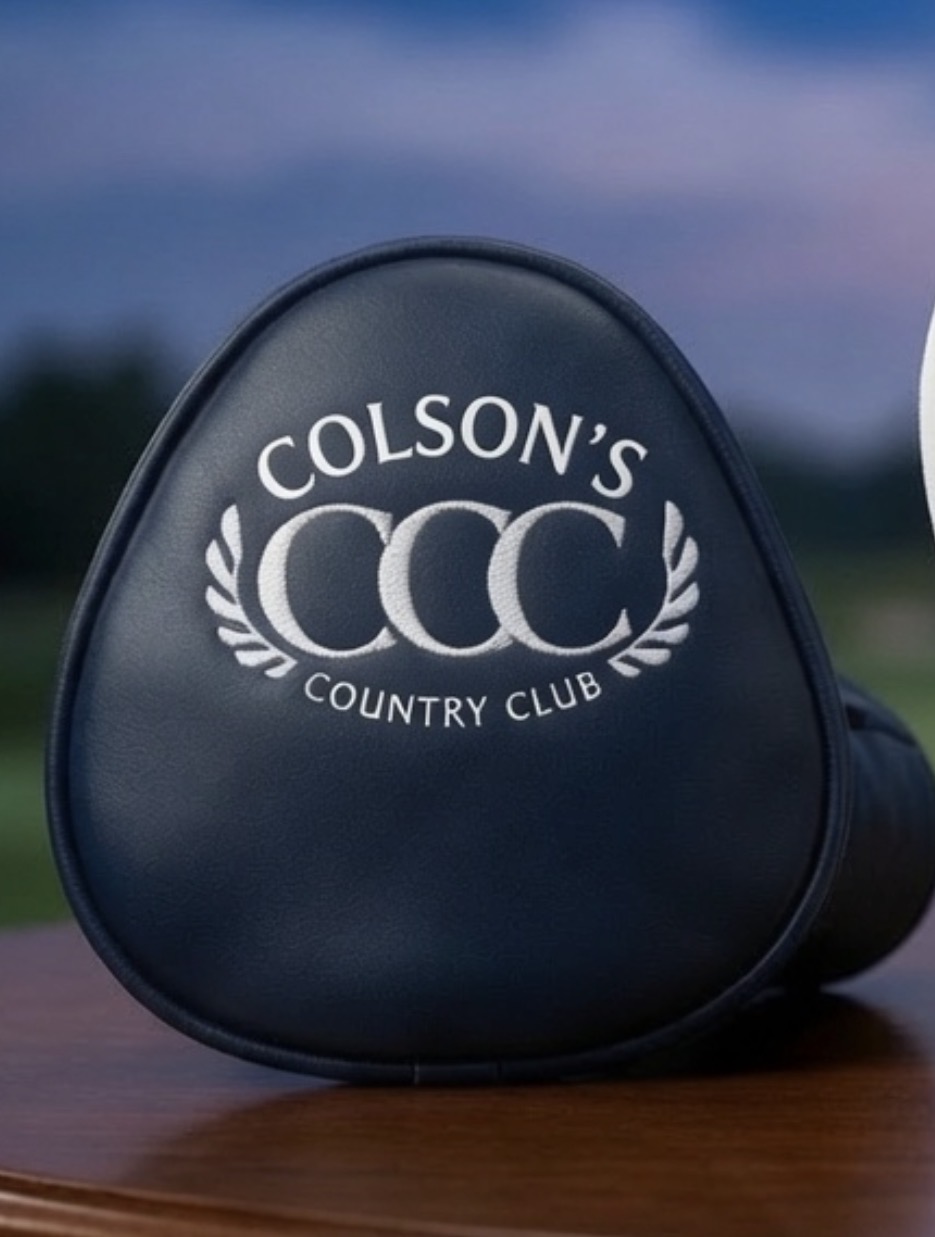
The full CCC line. Navy and cream. Laurel wreaths. Crossed clubs. A ball on a tee.
This is a man's coat of arms.
Now look closely at that crest, and then go look at the logo on the quarter-zip he wears
at his actual club. Same wreath. Same monogram treatment. Same crossed clubs, same ball on a tee, same font,
same navy. He did not design a logo. He took Triple Crown Country Club’s
crest — the crest of the real club, the one on the wooden plaque he and Mark Skiba are holding in the
championship photo — and he swapped out “Triple Crown” for “Colson’s.”
Think about the sequence of events required. He looked at the emblem of a real institution with a real course
and real dues and real members, and his conclusion was: close, but it should say my name. Then he had it
embroidered. Four times. In two materials. And then he brought them to that same club and put them on the bag,
in front of the members, where the actual crest is on actual signage.
Founded
Whenever the order shipped.
Members
One. Provisionally two, after August 29th, without her consent.
Course record
Held by Colson. Also set by Colson. Also verified by Colson.
Initiation fee
Whatever the embroidery cost, which he has never disclosed.
Dress code
Enforced. By him. On himself.
Greens committee
Colson. Grounds crew: Colson. Head pro: also Colson, alarmingly.
The navy leather with the laurel wreath. Laurels are traditionally awarded for victory. He ordered his in advance.
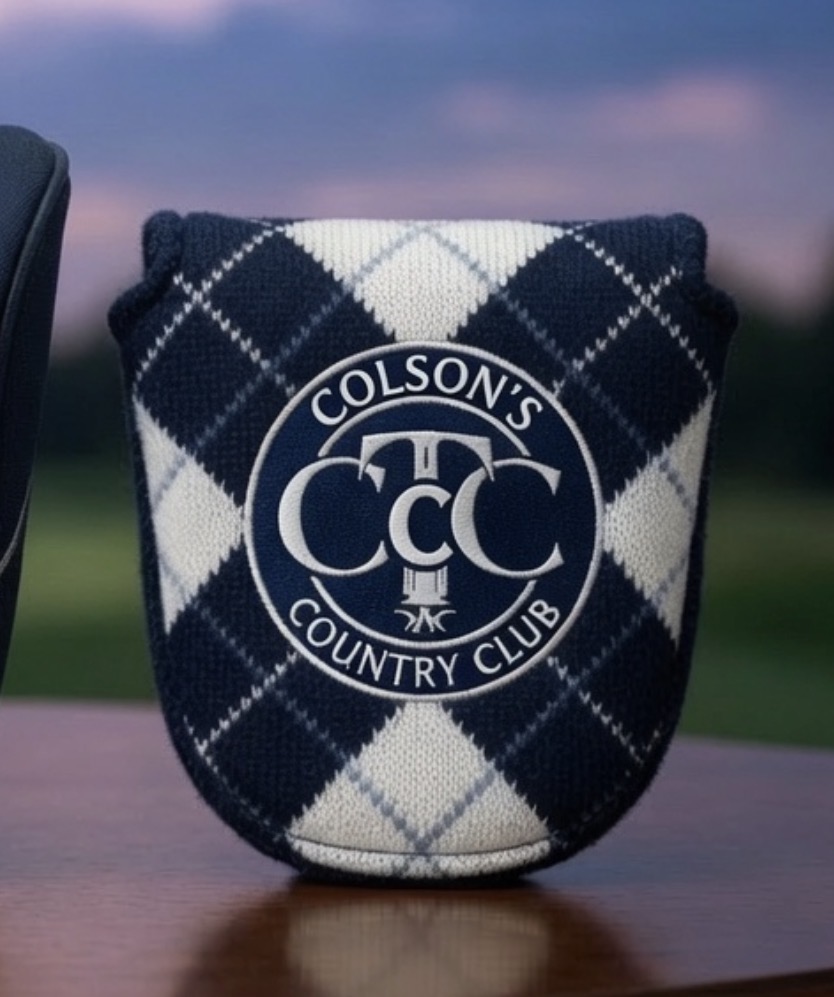
The argyle mallet. The crown jewel. Keep this one in mind — it comes back at the end of this page and it is devastating.
Augusta has a crest because it has a golf course. Colson has a golf course because he has a crest.
Equipment Studies, Soft Goods Division
Collection II: Tugboat Teddy
Five bears. Captain hats. Slogans that would not survive a corporate legal review.
The Tugboat Teddy line, photographed like an album cover, which it absolutely is.
Somewhere along the way, Colson Holland looked at his nickname, looked at his employer, looked at
the river, and decided the correct response was a five-bear product line in which each bear wears a captain’s
hat and says something that will get a father-in-law to raise an eyebrow. We are obligated to review these
individually. We are not happy about it.
Navy — “BUOY, DOES SHE BLOW!”
Opening statement. Nautical pun, exclamation point, small decorative wave. The bear is scowling, which is the
correct emotional register for a man who thought of this and then paid money to have it made. It is not even his
worst one. It is not close to his worst one.
Red — “I LIKE MY BUOYS BIG”
Here we go. This bear is smirking. It has an earring. There is a large buoy illustrated directly beneath the
text in case anybody in the foursome needed the diagram. Colson has put this on a driver and handed it to a caddie
at a member-guest without breaking eye contact.
Grey — “HARD TO STARBOARD”
The most technically defensible one in the collection. It is a real maritime command. It is also, obviously,
not just a real maritime command, and the bear’s expression — heavy-lidded, deeply unbothered —
confirms that everyone involved knew exactly what they were doing.
Black — “I PULL MORE THAN MY WEIGHT”
The mission statement. Little tugboat, little puff of smoke, a bear glaring out from under the brim like it
owes money. And here is the thing: on the 18th hole of the Triple Crown, this was factually incorrect, and
the contribution numbers back that up. He was carrying this cover on the bag at the time.
Mark Skiba never said a word about it. That restraint is why they won.
Olive — “ALL HANDS ON DECK”
Winking bear. Tongue out. And rather than a hand, an entirely different gesture, embroidered in full,
in thread, permanently. This is the one that will be in a photograph at the wedding. It will be in the background
of a picture somebody takes of the grandmothers. Nobody will notice until the album comes back.
The pattern. Every single slogan is about pulling, blowing, size, or hands. A man nicknamed
Tugboat, who is the CFO of a marine company, commissioned five bears and had all five of them make the same joke.
That is not a coincidence, that is a brand.
The Doctrine
The unwritten rules of the Holland bag, written down here for the first time.
Rule 1: Nobody else touches them
A caddie once removed the driver cover as a courtesy and the temperature on that tee box dropped fifteen degrees.
Colson did not say anything. He took the bear, re-seated it, removed it himself, and set it down at a specific
angle. Everyone understood. Nobody has done it since.
Rule 2: Re-covering is immediate and non-negotiable
The club is covered before the ball has landed. Before. The ball is still in the air, the outcome genuinely
unknown, and the bear is already tucked in for the night. On one occasion he covered the club, walked to the cart,
and then had to be informed he had hit it out of bounds.
Rule 3: The bears rotate by matchup
He selects the bear based on the opponent. This is real. Softer group, you get the navy. Guys he does not like,
you get the olive one with the finger, positioned outward on the bag, all day, at eye level, for eighteen holes.
It is psychological warfare conducted entirely through plush.
Rule 4: The 60-degree wedge has been stripped
Correct. After the 18th hole, the 60 was formally denied all cover privileges in what witnesses describe as a
brief, almost military ceremony. It now rides bare in the bag, exposed to the elements, as a warning to the other
clubs. The reason is documented here.
Rule 5: The argyle putter cover is immaculate
And here we arrive at the part that is too on-the-nose to be fiction. The single cleanest, least-worn,
most perfectly preserved piece in that entire bag is the CCC argyle mallet cover. Not a scuff on it. Not a mark.
Why? Because on the most important hole of his life, with eleven feet of clean fringe and a championship on the
line, he never took it off.
That argyle cover has been through an entire Triple Crown and it did not miss one minute of it.
The most expensive decision in Colson Holland’s golfing life
Cost-Benefit Analysis
Item
Amount
Notes
Custom collections commissioned
2
CCC and Tugboat Teddy
Country clubs founded
1
Does not exist. Has a crest.
Golf lessons taken, lifetime
0
He has “got it figured out”
Slogans referencing buoys
2
Out of five. Forty percent.
Obscene gestures embroidered in thread
1
Permanent. Machine washable.
Strokes saved by any of this
0
This is the whole point
What Olivia Should Know
These are coming with him. All of them. Both collections. The bears will live in your home. At some point
one of them will end up on a shelf, and one day you will be asked whether the red one or the black one looks
better by the door, and the correct answer is to pick one confidently and never revisit it.
Also, and we say this with love: he is going to try to get you a CCC cover. He may have already ordered it.
You are, as of August 29th, a founding member of a country club that does not exist, and the initiation
fee has already been paid.
Slowest unhittable pitch in the recorded history of American amateur baseball. The math is genuinely disturbing.
Let us be honest about the number, because the number is not good. Colson Holland's fastball topped out
at sixty-eight miles per hour. Sixty-eight. There are high school softball pitchers who would have to be talked down
off a ledge over sixty-eight. There is a speed limit in parts of Kentucky higher than his best pitch.
And yet. And yet.
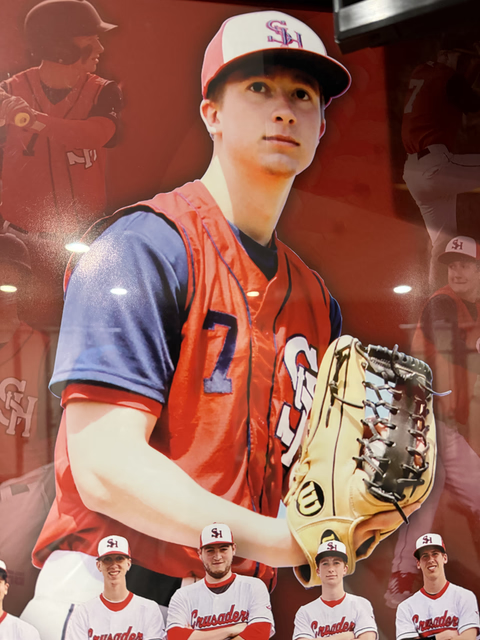
Number 7. On a banner. At the school. Permanently. A man does not get put on the wall for
sixty-eight miles an hour unless something else was going on.
68Max Velocity (MPH)
3,410Spin Rate (RPM)
67Changeup (MPH)
Why It Worked Anyway
Four explanations. At least one of them is true.
The spin rate was a felony.
Sixty-eight miles an hour at 3,410 RPM is not a fastball, it is a rumor. That ball did not travel toward
home plate so much as hover its way there while rotating like a drill bit. Hitters described it as arriving
“from above,” which is not a thing a fastball is supposed to do. It had nineteen inches of arm-side run.
Nineteen. Big league average is about fifteen, and those guys throw ninety-five.
The changeup was one mile an hour slower.
This is the part that breaks people's brains. Sixty-eight and sixty-seven. A one-mile-per-hour differential. That
should be the least effective pitch pairing ever devised by a human being, and instead it produced a swing-and-miss rate
that has never been satisfactorily explained. The leading theory is that hitters were so insulted by the first pitch
that they were not emotionally prepared for a second one.
The radar guns were calibrated in knots.
We want to flag this one, because it is our favorite and because it ties the entire website together. Every gun in the
Ohio River valley in that era was, allegedly, calibrated for marine use. If sixty-eight was a knots reading —
and we have no evidence that it was, but also nobody has produced evidence that it wasn't — then Colson Holland
was throwing seventy-eight point three miles per hour. The tugboat was always in him.
The tugboat has always been in him.
He was completely unafraid.
You do not get to sixty-eight miles an hour and keep taking the ball without a very specific kind of confidence.
He pitched inside. At sixty-eight. He brushed hitters back at a velocity they could have caught barehanded.
One documented instance exists of a batter stepping out of the box not because he was scared but because he was
confused about what was happening to him emotionally.
The Career Line
Category
Colson
Notes
Top velocity
68 MPH
Or 78.3, if you accept the knots hypothesis
Velocity separation, FB to CH
1 MPH
Should not work. Worked.
Arm-side run
19 in.
Four inches more than an MLB average fastball
Hit batsmen
6
All of them apologized to him
Pitches that reached the catcher on the fly
Most
Not all. Most.
Fear generated
0 MPH worth
Yet somehow non-zero
It came in at sixty-eight and it arrived at ninety-one. I have thought about that pitch more than I have thought
about most members of my own family.
Composite testimony of every hitter who faced him
The tragedy of it all. The same hands that generated 3,410 RPM of unhittable spin cannot,
thirty years later, advance a golf ball more than eighteen inches from a perfect lie on the fringe. And his father
still performs microsurgery inside the human cornea. Somewhere in that family the fine-motor genes took a hard
left turn. See the 18th hole.
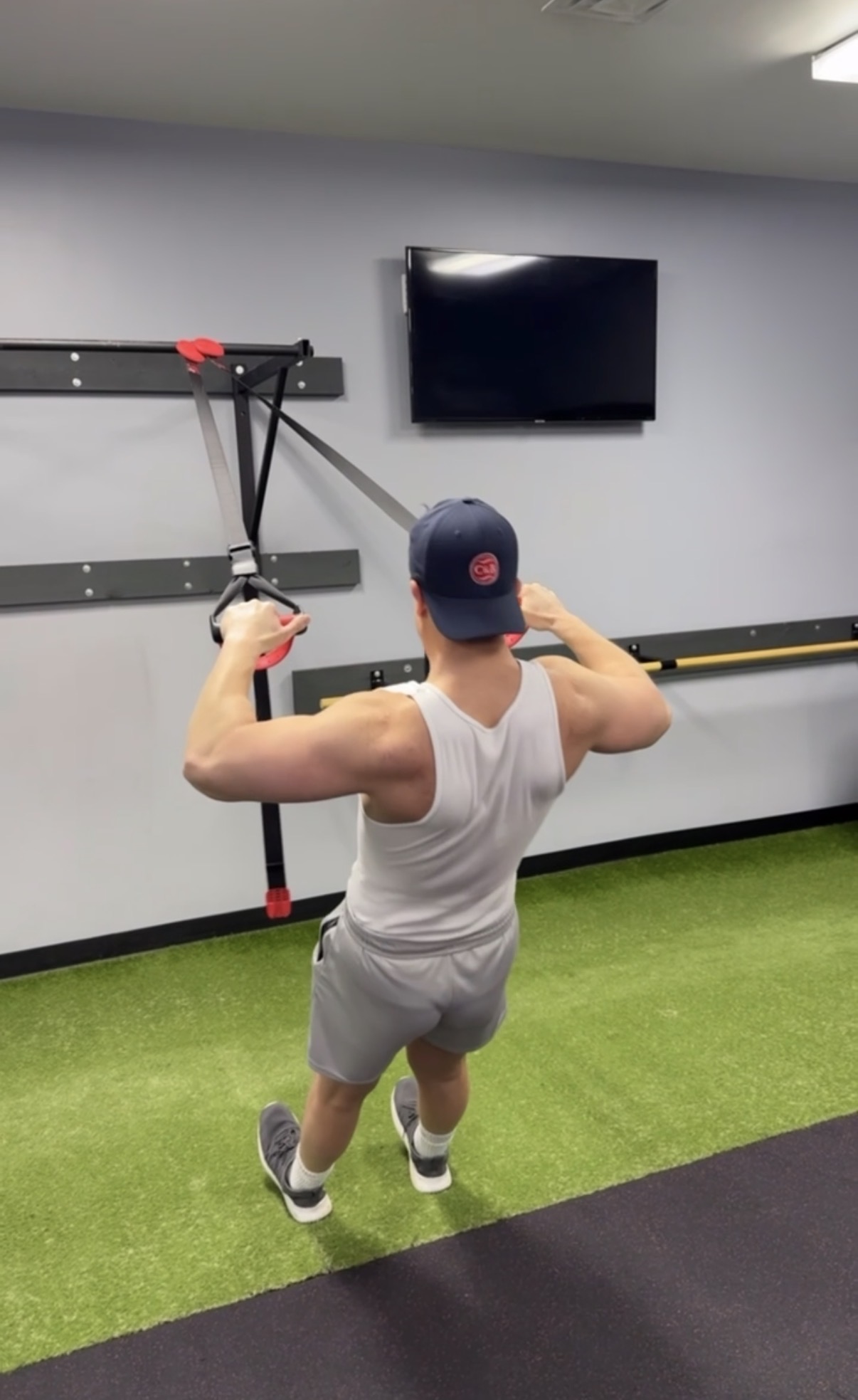
At some point in the last few years, Colson Holland decided to get significantly stronger. The results are undeniable. The shorts are indefensible.
We need to give credit before we take it away. The man is in genuinely excellent shape.
Arms, shoulders, back, quads — all of it, visibly, the product of real and repeated work that nobody
forced him to do. He shows up. He puts in the sets. For a guy whose fastball topped out at
sixty-eight miles an hour, the current build represents an enormous
personal comeback.
That is the entire compliment. It is over now.
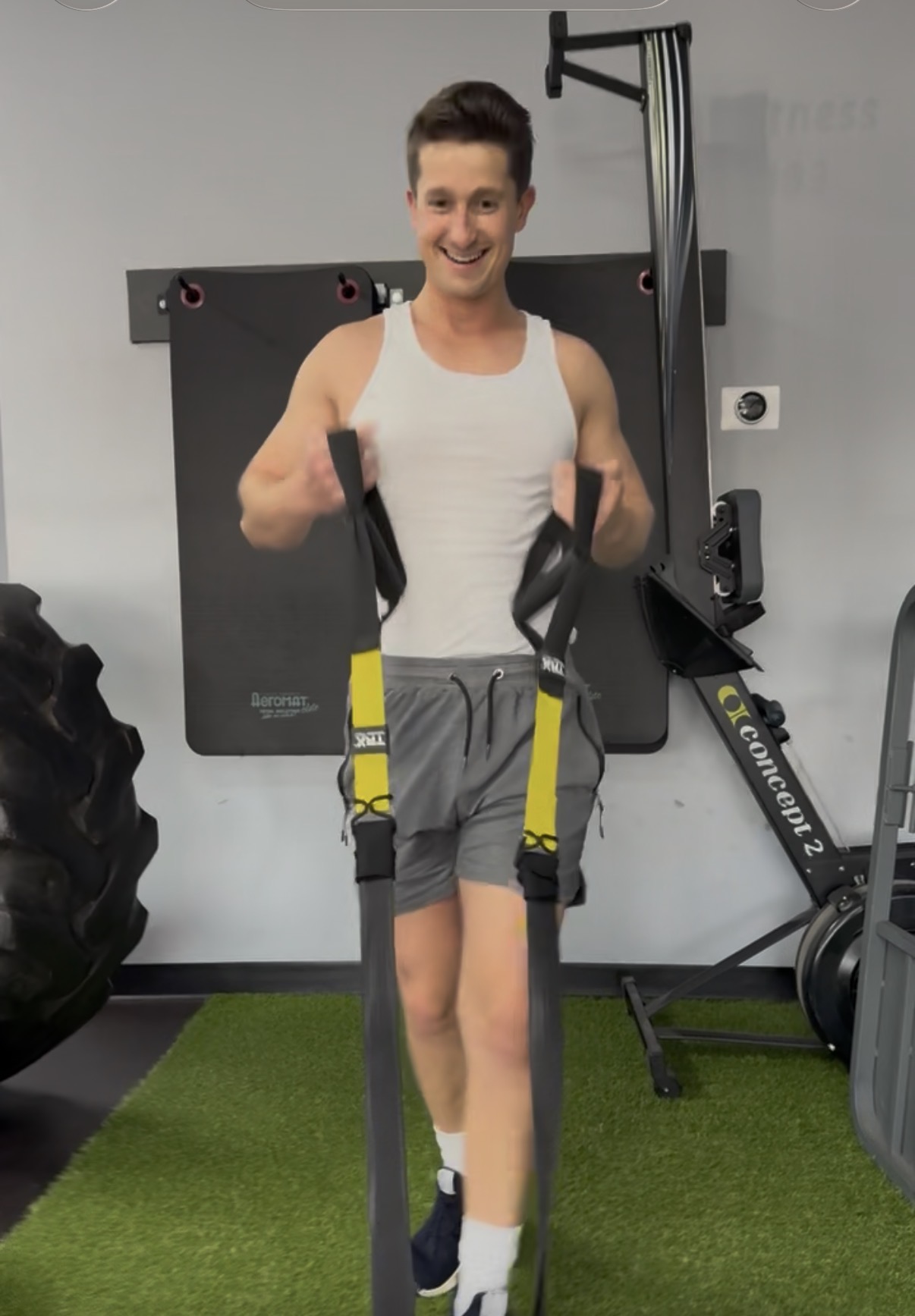
White ribbed tank. Grey shorts. Beaming. This is a man who is exactly where he wants to be.
0Sleeves Owned
3″Estimated Inseam
68MPH, Still
The Shorts
We have to talk about the shorts.
Grey. Short. Short. Not athletic-short. Not modern-five-inch-inseam short.
We are talking about a garment that has been photographed multiple times and in every single instance appears
to be losing a fight with his own quadriceps. There is more Colson Holland visible below the hem than above it.
A structural engineer would look at the load distribution and have concerns.
And here is what elevates it from a wardrobe choice to a personality trait: he knows.
He is smiling in every photo. He is aware of the shorts. He selected the shorts. Somebody in his life has
almost certainly said something about the shorts, and the shorts are still here. That is not an accident,
that is a platform.
Submitted without further comment. Note the hem. Note that both men are delighted.
Top half
Tank top. Always. White ribbed, black Under Armour, does not matter.
The sleeve was identified as an obstacle years ago and eliminated.
Bottom half
Minimal. Contested. Under review.
A man does not accidentally end up in shorts like that. A man arrives in shorts like that.
Wellness Desk, ongoing coverage
The back is, we have to admit, a real back. Built entirely so that it could one day fail to
move a golf ball eleven feet.
The Soundtrack
In one documented training session, the television mounted in the gym is displaying
“Walk This Way (feat. Aerosmith).” Not a playlist he stumbled into.
Not the gym’s music. A song, on a screen, selected, in a room where a man in a Reds tank top is flexing
next to him and both of them are having the time of their lives.
We have nothing to add. We simply feel everyone should know that this is the soundtrack.
The Central Contradiction
The strongest he has ever been. The weakest chip shot ever struck.
Feat
Result
Pulling a weighted sled across turf
No problem
TRX rows to failure
Repeatedly
Lat pulldowns, full stack
Comfortably
Carrying Olivia across a room for a photo
Effortless
Moving a golf ball 11 feet with a wedge
Could not
This is the thing that should keep sports scientists awake. A man built like that,
standing over a stationary ball sitting up on dry fringe, with a perfectly clean lie and a full backswing available
to him, could not produce eighteen inches of forward ball movement. Whatever he has been training, it is not that.
The incident is documented in full here.
Peaking for August 29th. He is going to be in the best shape of his life at that altar.
The tux is going to be tailored within an inch of its life. He is going to do one last set in the hotel gym
that morning. And Olivia, who fell for him years ago when he had none of this,
is going to look at him and love him exactly the same amount. Which he knows. Which is why he is doing it anyway.
On August 29th, a Holland marries a Hollman. One of those two families is clearly getting the better end of this deal.
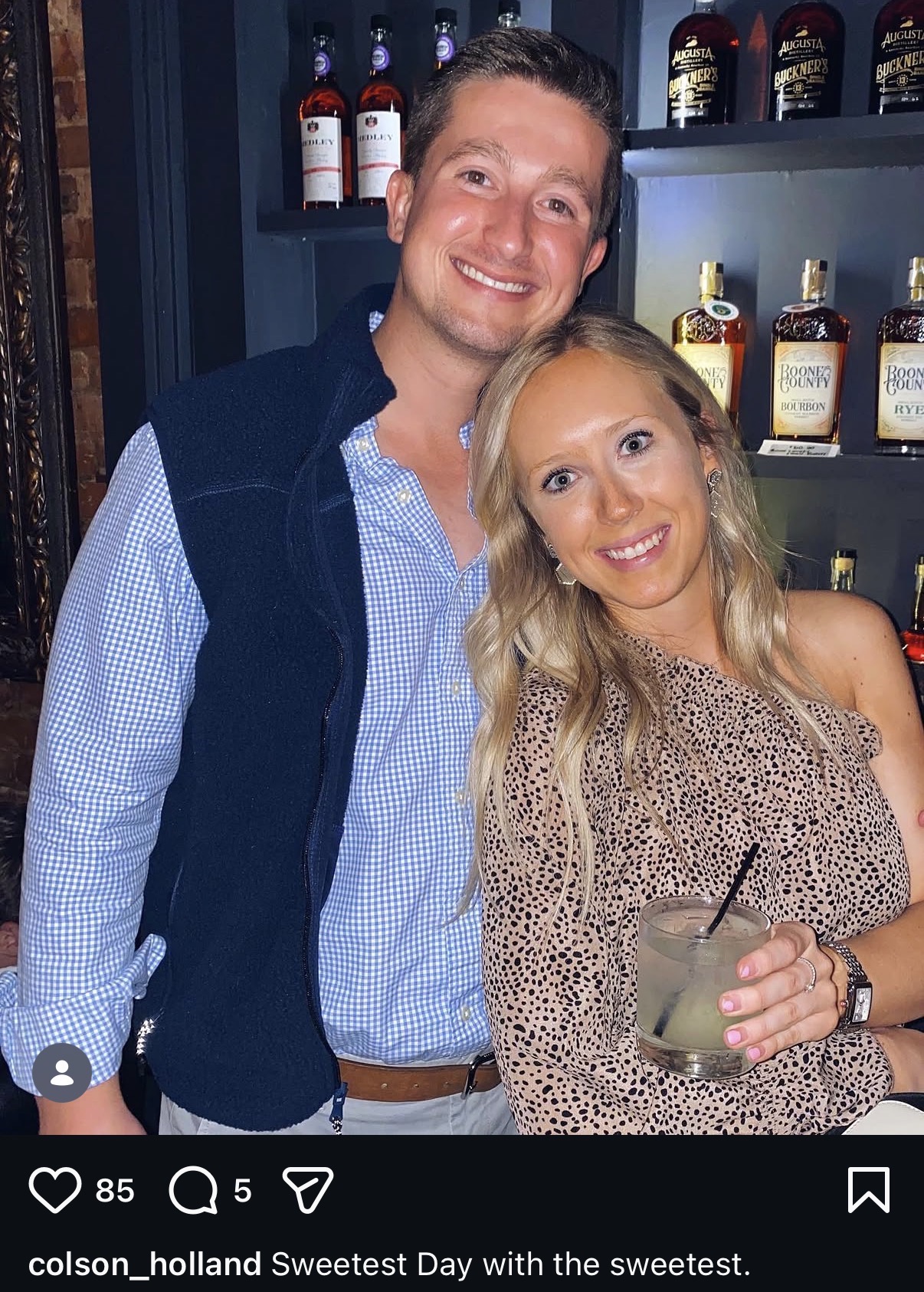
“Sweetest Day with the sweetest.” Eighty-five likes. He is a Chief Financial Officer.
He wrote that. He hit post.
There is a moment at every wedding when the bride comes through the doors and everybody turns to look.
And there is a second, much funnier moment, roughly a half-second later, when everybody turns to look at the groom
looking at the bride. On August 29th, that second moment is going to be the single greatest thing any of us
have ever witnessed, because Colson Holland is going to stand up there with the exact facial expression of a
man who has just realized the paperwork went through.
Let us establish the disparity.
The Bride is a smoke show. We are not going to dress that up in nicer language,
because there is no nicer language and everybody involved already knows. She walks into a room and the room
adjusts. Meanwhile Colson is a man whose nickname is a boat. A short, wide boat. A boat specifically known
for being the least attractive vessel on the entire river.
Her
Beautiful. Sharp. Funny in the dangerous way, where she lets you finish your whole story before dismantling it.
Well liked by literally everyone. Has never chunked a chip shot in her life, largely because she was smart enough
to never take up golf.
Him
Tugboat.
He is punching so far above his weight that the officiating commission has opened an inquiry.
Preliminary findings
On The Age Gap
He did not rob the cradle. But he was in the room. He was near the cradle.
We want to be extremely clear and legally precise: Colson Holland did not rob the cradle. Everybody is a
consenting, tax-paying, fully licensed adult and the whole thing is completely above board.
That said. He was close enough to the cradle that he could hear the mobile playing. Close enough that
when they compare cultural references there is a soft, unspoken pause. Close enough that he has had to explain
what a Blockbuster was. Close enough that at least one wedding guest is going to do the math on a cocktail napkin
and then look up sharply.
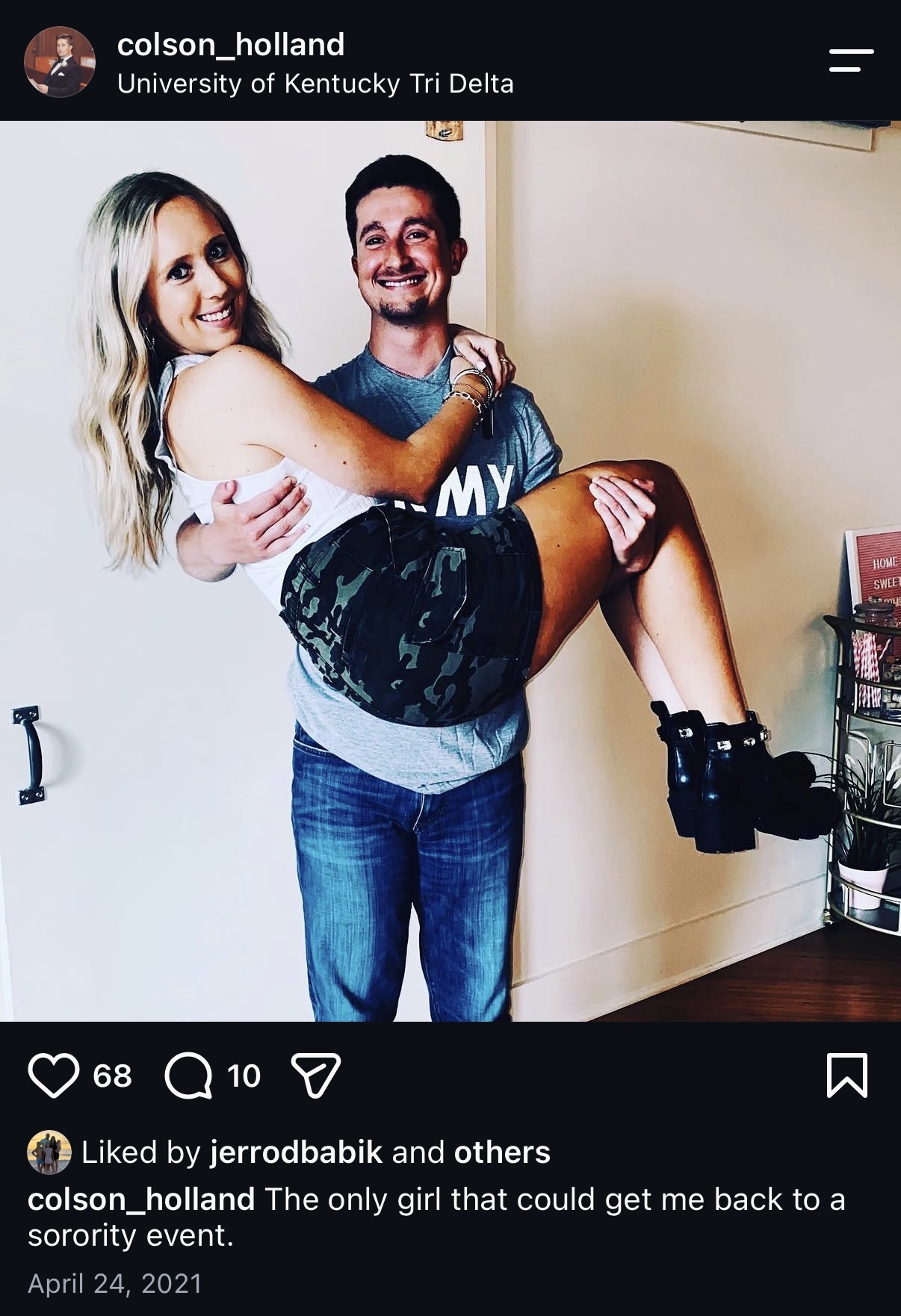
We would like to enter one piece of evidence. On April 24th, 2021, Colson Holland posted a photograph of
himself carrying Olivia across a room, tagged University of Kentucky
Tri Delta, captioned:
April 24, 2021. Tagged: University of Kentucky Tri Delta. Sixty-eight likes, ten comments.
The only girl that could get me back to a sorority event.
@colson_holland, April 24, 2021
“Back to.” Back to. A grown man with a salary and a 401(k) and opinions about
bond duration, returning to a sorority function, and being so pleased about it that he documented it publicly.
Sixty-eight likes. Ten comments. We have read all ten and several of them are just people typing the word
“sir.”
Official ruling: Cradle intact. No larceny occurred. Cradle-adjacent activity acknowledged.
Case dismissed with a warning and a raised eyebrow.
The Hollman Family
The people who, against all available evidence, approved this.
Here is the thing that says the most about the Hollmans: they said yes. They met a man whose entire public
identity is a river vessel, watched him mention his father's surgical career four separate times in one dinner,
presumably heard about the chip shot on 18 at some point, and they let him in anyway. That is grace.
That is real, unearned, biblical grace.
They are, by every account we have collected, an outstanding family — the kind where the holidays are loud,
the door is always open, the food situation is aggressive, and everybody hugs on arrival whether you were emotionally
prepared for it or not. Colson is not just marrying The Bride. He is being absorbed
into a functioning ecosystem, and he is lucky twice over.
What she gets
A CFO with a stable job, a nickname she has already accepted, a father-in-law who is the best eye surgeon
in the world, and a husband who will love her with an intensity that is frankly a little embarrassing to watch.
What he gets
Everything. All of it. The whole thing. He gets absolutely everything and he knows it, and if you look closely
at him during the vows you will see the exact moment he thinks about it.
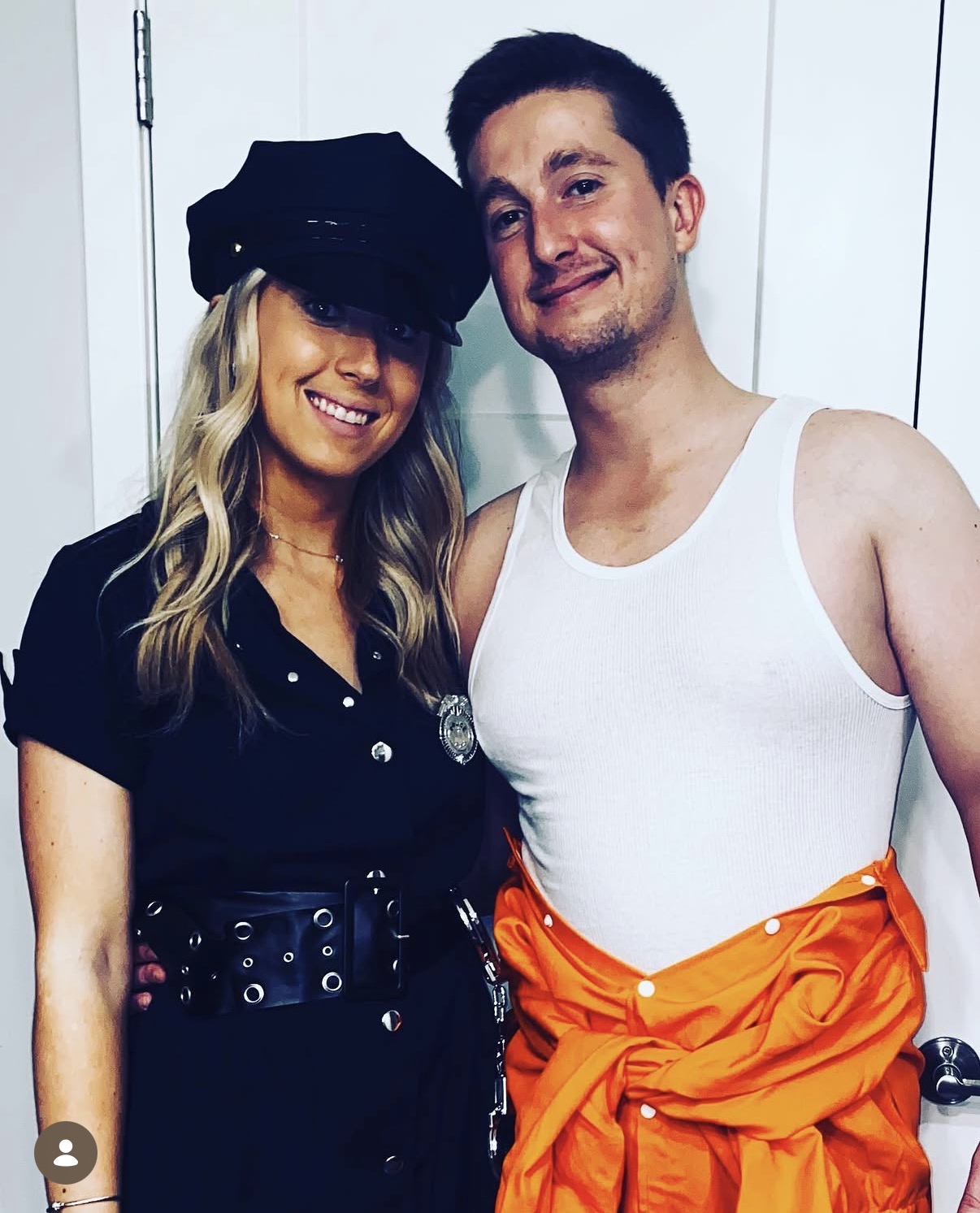
She went as the cop. He went as the guy in custody. At no point did anyone involved
consider this a metaphor, which is exactly why it is one.
Nobody at this wedding will be asking what she sees in him. Everybody at this wedding will be asking
what she sees in him.
The seating chart, allegedly
Thirteen exhibits. All real. All voluntarily made public by the subject. Click any image to enlarge.
Exhibit Group A — The Championship
A1. “Congratulations to our 2026 Member Member Champions, Mark Skiba and
Colson Holland.” Two wooden plaques. Equal billing. Wildly unequal contribution.A2. The confession. October 26, 2025. “Picked a good horse and rode it to
victory.” He announced the strategy a full year before running it on Mark Skiba.
Exhibit Group B — The Headcovers
B1. The full CCC line. He took Triple Crown Country Club’s crest and
replaced “Triple Crown” with “Colson’s.”B2. The argyle mallet putter cover. Spotless. Because on 18 he never took it off.B3. Navy leather, laurel wreath. Laurels are awarded for victory. He ordered his up front.B4. Tugboat Teddy. Five bears, five captain’s hats, five slogans about
pulling, blowing, size, or hands. One of them has a hand gesture embroidered in thread.
Exhibit Group C — The Physique
C1. The shorts. Also note the screen: “Walk This Way (feat. Aerosmith).”
That is the soundtrack. That was chosen.C2. White ribbed tank, grey shorts, full beam. A man exactly where he wants to be.C3. It is, we concede, a real back. Built over years, deployed on 18 to move a
golf ball eighteen inches.
Exhibit Group D — Olivia
D1. “Sweetest Day with the sweetest.” 85 likes. Written by a
Chief Financial Officer, voluntarily, in public.D2. April 24, 2021. University of Kentucky Tri Delta. “The only girl that
could get me back to a sorority event.” Back. To.D3. She went as the cop. He went as the guy in custody. Nobody involved
considered this a metaphor, which is precisely why it is one.
Exhibit Group E — The Fastball
E1. Number 7, on the wall, permanently. Sixty-eight miles an hour and they still
put him on a banner. Something else was clearly going on.
Evidence Not Yet Obtained
The investigation remains open.
Video of the chip shot on 18. The putt was filmed. The chip was not, or somebody is sitting on it. Come forward.
The divot. Reportedly still visible from the clubhouse under the right light.
Radar gun readings from the 68 MPH era, ideally with the calibration units clearly labelled.
The invoice for the Colson’s Country Club embroidery run.
Any photograph in which he does not look mildly amazed to be standing next to
Olivia.
The Triple Crown was the second-biggest upset of his year.
—Days
—Hours
—Minutes
—Seconds
Until Colson Holland marries The Bride and this entire website
becomes a historical document.
Order Of Events
Unofficial. Predicted with high confidence.
Time
Event
Morning
Colson tells four separate people that his father is the best eye surgeon in the world. Unprompted. All four already knew.
T-minus 60 min
Someone confirms he did in fact bring a putter, just in case.
Processional
Doors open. Room turns. Groom's face does something none of us have seen before.
Vows
He gets through approximately eleven words.
Recessional
The horn. You will hear the horn. Everyone will hear the horn.
Cocktail hour
The 18th hole comes up within nine minutes. He blames the grain.
Dinner
Second dinner.
Reception
Multiple attempts to put Tugboat on the ground. All fail. Low center of gravity.
Late
The Partner is handed a microphone. Says almost nothing. Destroys the room.
A Toast
Colson, you chunked the most important chip shot of your life from a perfect lie with a putter
sitting right there in your bag, and somehow you still ended up with your name engraved on a Triple Crown.
We have thought about that a lot this year, and we have decided it is not a story about golf.
It is a story about a guy who keeps ending up on the winning side of things he probably should not have won,
because he has spent his entire life tying himself to people who are better than him and then pulling like hell.
Your dad, who is the best in the world at something and whose shoes you will never come close to filling —
and who, for the record, does not care even slightly. Your firm. Your partner on 18. And now
The Bride, who is out of your league by a margin that has caused genuine confusion
among your friends.
That is not luck. That is the whole skill. Recognizing something better than you and refusing to let go of the line.
It is the least glamorous boat on the river and it is the one everybody calls when it matters.
You will never fill your father's shoes. Nobody will. But you found somebody who does not care about that at all,
and that is the better outcome.
Everybody who is going to be in that room on August 29th
Congratulations, Tugboat. Now for the love of God, putt it.